

Assam, India
When your Google traffic drops, I find out why.
For more than eight years I've worked on one kind of problem: a site that used to get traffic from Google and suddenly doesn't. It might be a core update, a penalty, a hack or a move that went wrong.
I start in your Search Console, work out what actually happened, and tell you in writing whether the traffic can come back. You get that answer before you pay for any fixing.
Run a business in India? See SEO for Indian businesses that sell abroad, or prices in rupees.
When did your traffic fall?
Pick the day. I'll check it against every confirmed Google update since November 2021.
Which drop looks like yours?
Open the Performance report in Search Console and look at the shape of the line. These are the seven shapes I see most, what each one usually means, and a check you can do yourself before you pay me or anyone else.
Everything fell on one day, close to zero
- Usually
- A manual action, a noindex or robots.txt mistake, or a site that has dropped out of the index. Algorithm updates almost never do this in a single day.
- Check
- Open Security & Manual Actions, then Manual actions. Then run URL Inspection on your homepage and see if it says the URL is on Google.
A slide over two or three weeks
- Usually
- A core update or a spam update, if the dates line up with a rollout. Use the date check above.
- Check
- In Performance, compare the four weeks before the rollout with the four weeks after it. Open Pages and sort by the difference in clicks. The pages at the top are where Google changed its mind.
Only one folder fell, like /blog/
- Usually
- Google has judged that section, not the whole site. The usual reason is pages published in bulk: templates, rewrites, or articles written to catch searches.
- Check
- In Performance, add a Page filter for URLs containing the folder, then compare it with the rest of the site over the same dates.
Impressions held, clicks fell, position about the same
- Usually
- You haven't lost rankings. Something on the results page is taking the click, most often an AI Overview. In my study of seven sites, the one with 1.7% AI exposure got 4.3% click-through at a top-10 position. Three with 21 to 31% exposure got 0.7 to 1.1%.
- Check
- Search your top five queries yourself, signed out, and note what sits above your result.
Clicks jumped on searches you never targeted, then fell
- Usually
- The site has been hacked and is serving spam pages, often in another language. The real pages lose traffic after that.
- Check
- In Performance, open Queries and look for casino, pharmacy or Japanese terms. Then open Security issues.
It fell right after a redesign or a domain move
- Usually
- Redirects. Old URLs that 404, redirect to the homepage, or chain through several hops before they land.
- Check
- Run URL Inspection on five old URLs that used to get traffic. Then open Indexing, Pages, and look for a jump in Not found (404).
Clicks and impressions fell together, about this time last year too
- Usually
- Fewer people are searching. That's demand, not a penalty, and it isn't something I can fix.
- Check
- Set the date to Compare, last 3 months year over year. If last year's line made the same dip, you're looking at a season.
Real drops, from Search Console
In late September it went from almost nothing to 52,696 clicks a day. Then, in the middle of Google's September 2026 spam update, it fell to 581. It was back above 24,000 a day on 9 October, the day after the rollout finished.
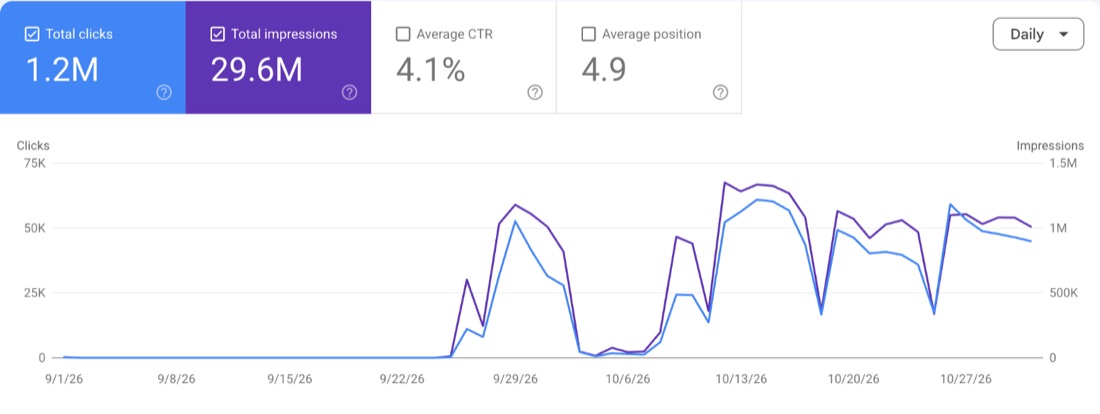
Not every drop comes back. One client site I work on was hacked: its clicks went up eight times in a week, then it lost three quarters of its real traffic. I wrote up that case, with the real numbers.
How I answer, in public
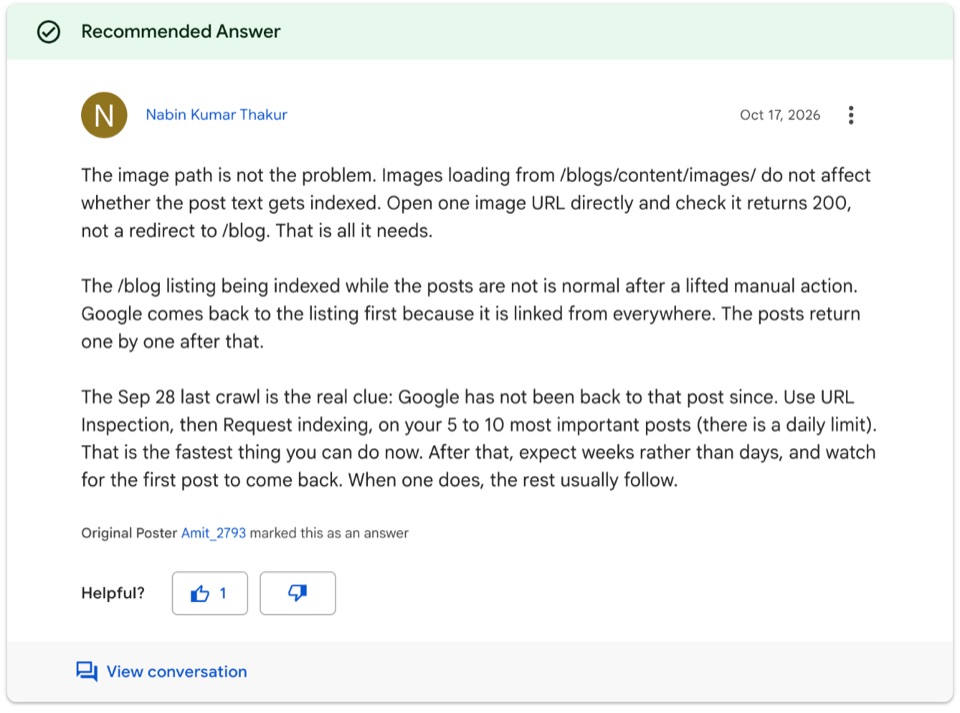
I answer recovery questions on Google's own Search Central forum, where anyone can check them. This one was to a US hosting company whose help centre got a spam penalty, and whose first reconsideration request had been rejected.
My reply on the Search Central forum, 24 October 2026
“What I think a reviewer sees is in your sitemaps. The knowledge base lists about 2,655 articles, and more than 2,100 of them show as modified since 14 October, at a steady 200 to 240 a day…”Read the full reply
I don't think Cloudflare or crawling is the issue. I fetched one of your KB articles as Googlebot and as a normal browser and got the same page both times.
What I think a reviewer sees is in your sitemaps. The knowledge base lists about 2,655 articles, and more than 2,100 of them show as modified since 14 October, at a steady 200 to 240 a day. For example, the 2016 VestaCP install guide was retitled and rewritten this morning. Rewriting at that pace looks automated, and it matches the "scaled content abuse" wording in your notice almost exactly. Sending a new request while that is running will most likely be rejected again.
What I would do:
- Pause the batch rewrite.
- Sort the articles into three groups. Keep: help for your own products and services that customers actually use. Noindex or remove: general tutorials for software you don't host or support, outdated guides, and general news. Merge: articles that cover the same task.
- Rewrite the keepers by hand, checked against your real setup, a few at a time.
- Then file the reconsideration request with numbers: how many articles were removed, noindexed, merged and kept, a few examples of each, and how the help centre will be written from now on.
The next day they cut the help centre from 2,655 articles to 88. All my forum replies are here.
Prices
Every price is fixed. You know the cost and the scope before you pay, and there's no monthly contract.
| Drop Check | A written answer in 3 working days: what most likely caused the drop, and whether it looks recoverable. You give me read-only access to Search Console.If I can't tell you what most likely caused the drop, you get the $249 back in full. If you go ahead with the audit, it counts toward it. | $249 |
|---|---|---|
| Recovery Audit | The full diagnosis in 5 working days, with a fix plan in priority order. | $1,500 |
| Recovery Fix | The audit, and then I make the fixes myself over 14 days. For a manual action, I also write the reconsideration request. | $4,500 |
See every option. Based in India? Prices in rupees are here.
What happens after you email me
- Within a day
- I reply and tell you whether it looks like something I can help with. That part is free.
- If it is
- You add me to Search Console as a read-only user and pay for the Drop Check. I never need your password.
- 3 working days later
- You get the written answer: what happened, whether it's recoverable, and what I'd do first.
- Then
- You decide whether to go ahead. If it's not worth fixing, I'll tell you that too.
What clients have said
“The recommendations are generally practical and connected to our business objectives rather than being generic SEO advice.”
Madhav Reddy Pujan Pujari, Dalvkot Pharma, on Trustpilot
“Nabin is great at what he does. He is prompt and professional.”
Nikhil Gupta, on Trustpilot
“Good service last 3 years I use there service Navin is a very supportive person”
Lakhyajit Boruah, HTH Travel Services, on Trustpilot
Tell me what happened
Send me your site address and roughly when the traffic fell. That's enough for me to tell you whether it's worth a closer look. I read every message myself.
Nabin
- hello@seorevive.in
- +91 96748 29581
- A call
- Book 20 minutes, free
Not ready to talk? Run the free site check first. It needs no sign-up.