Recovering from Google's Helpful Content Update: A 2026 Playbook
In March 2024, Google folded the Helpful Content classifier into the core ranking system. Most of the recovery advice you'll find online was written before that change, and almost none of it accounts for what we learned from the May 2024 API leak. This is the playbook I use now, with the clients I'm actively working with, post-2024.
How do you recover from a Google core update or Helpful Content hit? You prove to Google your site is genuinely more helpful than it judged it to be, then wait for a later core update to re-assess it. There’s no button to press and no reconsideration request: it’s an algorithmic re-rating, not a manual penalty.
Four moves: (1) confirm an update actually caused the drop, (2) find the unhelpful, thin, or search-engine-first content dragging the whole site down, (3) fix or remove it and strengthen real-world expertise (E-E-A-T), and (4) hold steady until the next core update re-evaluates the site: typically 2–6 months, sometimes longer. Full recovery is common but never guaranteed.
- Google shipped 3 updates named “helpful content”: August 2022, December 2022 and September 2023. They took 16, 39 and 14 days to roll out.
- The last one finished on 27 September 2023. Since then 22 ranking updates have started (11 core, 9 spam, 1 reviews, 1 Discover) and none carried the name.
- Re-assessment now arrives with core updates. The gap from the end of one to the start of the next has a median of 95 days (range 8 to 176).
Worked out from our dataset of every confirmed Google update, built from Google’s Search Status Dashboard. Rollouts count every calendar day from announced start to announced completion.
- The "Helpful Content Update" isn't an event anymore. Since March 2024 it runs continuously inside Google's main algorithm. There is no "next HCU" to wait for.
- Google grades your whole site, not just individual pages. If most of your content is thin or filler, even your good pages get held back.
- Recovery is mostly about cleaning up at scale. You usually remove or rewrite 20–50% of your pages, then wait weeks for Google to re-check. There is no 30-day fix.
- "Bad content" isn't about word count. It's about whether a real person actually wrote it from real experience, or whether it reads like generic filler.
The rest of this page is the full diagnostic, in the order we actually run it. Start with working out which update hit you, because getting that wrong costs months.
If you would rather hand the whole thing over, that same sequence is what our Google penalty recovery service does, at a published price (here is what recovery typically costs, ours and other providers’). If you want a second opinion first, book twenty minutes and send your URL when you do, so the site gets read before the call rather than during it.
Three things changed in 2024, and they changed everything
- HCU is no longer a separate update. Google announced in March 2024 that the helpful content classifier was rolled into the core ranking system. There is no "next HCU update" to wait for, and that merge changed the diagnosis and the timing, not just the label. The classifier runs continuously, on every crawl.
- The May 2024 API leak gave us names. Attributes like
siteAuthority,siteFocusScore,hostAge, and acontentEffortscore appeared in the leaked documentation, and they map closely to what HCU appears to measure. Google has not confirmed how these attributes are weighted, but their existence is now public record. - The 2024 spam policy expansion. Alongside the March 2024 core update, Google added explicit policies for scaled content abuse, site reputation abuse, and expired domain abuse. Recovery isn't only about HCU anymore. It's about the broader quality framework these policies represent.
If you're reading recovery advice written before April 2024, throw most of it out. The mechanics changed.
Which 2026 update actually hit you?
This question matters more than any fix further down this page, because a wrong diagnosis sends you down the wrong road for months. If you already know the date your traffic changed, our Google update matcher will tell you which updates were rolling out that day before you read another word.
Google shipped six ranking updates in the first eight months of 2026, and they were not all the same kind of thing. The dates below are Google's own, taken from the Search Status Dashboard.
Start dates and rollout durations are as Google publishes them. Finish dates are calculated from those two figures, which is why they carry a tilde. Google confirms the duration, not a finish date.
Which window did your drop fall in?
Pull the exact date your traffic turned from Search Console, then enter it. Core and spam updates need opposite fixes, so this is the first thing worth getting right.
This checks all 41 confirmed updates since November 2021, not just the six in the table. If you want the rollout durations next to them, the full rollout-window matcher lists every window with the time Google took to finish it.
Core updates and spam updates are not the same problem. A core update reassesses how well your pages serve a query. That is the quality-and-helpfulness territory this guide covers, and the playbook below applies to it.
A spam update enforces specific written policies: scaled content abuse, site reputation abuse, expired domain abuse. If you dropped during a spam window, rewriting thin pages will not save you. You need to find the policy violation and remove it.
Three things follow from that table:
- Match your drop to the window, not to the month. The March 2026 spam update and the March 2026 core update started three days apart. A site that fell in late March could be facing either problem, and the two fixes barely overlap. Pull the exact date your traffic turned before you decide.
- The May 2026 core update is the one most helpfulness-affected sites should study. At nearly twelve days it was the longest core rollout of the year, and it remains the most recent broad reassessment of content quality: more relevant to a helpfulness problem than anything shipped since.
- If your traffic fell in the last two weeks of August 2026, or between 24 September and 8 October 2026, this guide may be the wrong one. The August 2026 spam update finished rolling out around 20 August, and the September 2026 spam update ran from 24 September to 8 October. Check your policy exposure first.
One thing has not changed, and it is the most useful fact on this page: there is still no standalone "helpful content update" to recover from. The classifier was folded into the core ranking system in March 2024. That is precisely why the list above matters. Every core update since is a fresh chance to be reassessed. Two of them landed in 2026 alone.
Were you actually hit by HCU?
Most "I think I got hit" reports are misdiagnosed. Before you start a recovery, confirm what you're dealing with. Several other failures look very similar to HCU and require completely different fixes.
Open Google Search Console. In the Performance report, set the date range to "Last 16 months" and look at the daily clicks chart.
The HCU signature looks like this:
- The drop is sharp, usually within 1–3 days, not gradual
- The drop coincides with a confirmed core update date (the relevant ones for HCU-class signals: March 5 2024, August 15 2024, December 12 2024, and any subsequent core updates)
- The drop is site-wide. Most or all pages affected, not a few sections
- Impressions drop too, not just clicks (rules out a CTR or SERP-feature issue)
- No manual action notification in Search Console
- Recovery has not happened automatically over time
You can have most of that list checked for you. Working through it by hand means squinting at a 16-month chart and cross-referencing update dates. Connect Search Console read-only and it finds the drop date itself, tells you whether the fall was sharp or a slow slide, confirms whether impressions fell alongside clicks, matches the date against every confirmed update, and lists the pages and queries that actually lost the traffic.
It cannot see manual actions, so that one is still on you. Nothing is stored, access expires within the hour, and the permission is read-only. If you would rather not connect an account at all, the update matcher does the date check on its own.

What looks like HCU but isn't:
- Gradual decline over 4–6 weeks: usually a technical issue: accidental
noindex, robots.txt mistake, broken canonical, or migration aftermath - Drop affecting only specific URL patterns: probably an algorithm targeting a specific content type (e.g., the parasite SEO sweep against rented subfolders)
- Drop with a manual action message in GSC: not algorithmic: fix the manual action first, recovery is different
- Drop only on mobile or only on desktop: probably Core Web Vitals, mobile usability, or rendering
- Drop the day after a site migration: the migration broke something: check redirects, internal links, canonicals before assuming HCU
- Clicks that spiked before they fell: if click-through rate climbed sharply while impressions stayed flat in the weeks before the drop, that is the signature of injected content ranking on your domain, not a quality problem. We published the day-level Search Console data from one of these, where the site was ranking position 1.5 for a gambling brand and Search Console reported no manual action and no security issue throughout.
Was it actually HCU-class?
Seven questions, straight from the two lists above. Answer from your Search Console data rather than memory. If anything points elsewhere, this will say so and name the likelier cause.
Cross-reference your drop date with public update trackers (Search Engine Roundtable, Semrush Sensor, Sistrix Visibility Index for your domain). If the dates align with a confirmed core update and the pattern matches above, you're dealing with HCU-class signals. (If your drop lines up with a broad core update specifically, our Google core update recovery playbook covers the relative-quality re-assessment in depth: the two problems overlap now that the classifier lives inside core.) Continue.
What the HCU classifier appears to measure
The plain-English version first. Google looks at every page on your site and decides whether it's helpful or filler. Then Google looks at the whole site and asks: "are most of these pages helpful, or mostly filler?" A site that's mostly filler gets pushed down everywhere, even on its good pages.
So recovery means doing two things at the same time: cutting the filler, and making the good content genuinely better. Now the details on how this actually appears to work.
I'll say "appears to measure" throughout this section. Google does not publish the algorithm. What we have:
- Google's official guidance on creating helpful, reliable, people-first content
- Public statements from John Mueller, Danny Sullivan, and the Google Search Central team
- The May 2024 leaked API documentation revealing roughly 14,000 ranking attributes
- Observed recovery patterns across sites that did and didn't bounce back
Cross-referencing those, HCU appears to be a site-level multiplier built from per-page signals. The per-page signals correlate with:
- First-hand experience markers. Original screenshots, original data, specific anecdotes, named products / places / people, photographs you took yourself. Pages that read like the writer has actually done the thing.
- Author attribution. Whether the page says who wrote it, and whether that person plausibly knows the subject. I measured this across 38 law firms and 1,122 posts and 76% named no lawyer at all. It is the cheapest of these signals to fix and the one most often left broken.
- Information gain. Content that adds something the top 10 ranking pages don't have. A page that just summarises what's already ranking adds zero gain.
- Author signals. Real author with verifiable credentials,
Personschema,sameAslinks to authoritative external profiles (LinkedIn, conference talks, recognisable bylines elsewhere). - Effort indicators. Custom illustrations, original research, structured data quality, internal linking depth. The leaked
contentEffortattribute appears to score this. - User satisfaction proxies. Click-through rate from the SERP, dwell time, return-to-SERP behaviour. Google has consistently denied these are direct ranking signals; the leak suggests they're at least observed.
- Site focus. A site that covers many unrelated topics scores worse than a topically-focused site. The leaked
siteFocusScoreattribute appears to measure this. A site about SEO that publishes 200 articles on cooking will fight an uphill battle.
The site-level multiplier is the part that surprises people. Think of a restaurant: if 8 out of 10 dishes are mediocre, the place gets a bad overall rating, even if 2 dishes are excellent. Google appears to work the same way for websites.
It judges the whole based on the proportion of pages worth visiting, then applies that single judgement to every page on the site. Five excellent pages can't lift the score if there are 500 mediocre ones around them.
This is why recovery requires aggressive cleanup, not just polishing your best work. You have to fix the proportion.
The recovery playbook
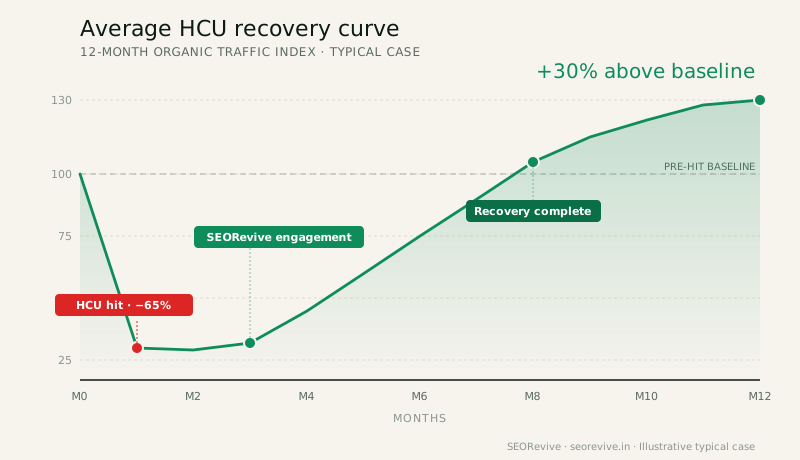
Set realistic expectations first. "90-day playbook" means 90 days of work. After the work, recovery is a function of how often Google recrawls and re-evaluates your site. For most sites that means 1–3 additional months before meaningful movement, sometimes longer. Anyone promising 30-day recovery either doesn't understand how the classifier works or is lying.
Where you are, and what to expect when
Enter the day the cleanup work starts. This converts the ranges in this section into dates on your calendar. It is not a prediction of when you recover, and nothing here can be: the re-evaluation runs on Google's clock, not yours.
Phase 1: Diagnose (Week 1–2)
Don't guess at what's wrong. Build the evidence first.
1. Pull a complete URL inventory. Run Screaming Frog on the site. The free version handles up to 500 URLs; if you have more, the licence pays for itself on the first audit. Export the full crawl with HTTP status, title, meta description, word count, indexability status, and inlinks.
2. Pull GSC data for the last 16 months. Search Console → Performance → Pages tab. Sort by clicks descending. Export. Then sort by impressions descending and export again. The first list shows what's working; the second shows what Google still sees but isn't sending traffic to.
3. Identify the "zombie" pages. Pages with high impressions but near-zero clicks are the ones Google indexes but has lost confidence in. These are usually your strongest HCU recovery candidates. Google still thinks they're relevant but doesn't think users will be helped.
4. Identify the thin pages. From the Screaming Frog export, filter to pages under 500 words. In most niches, thin pages need to be either improved or removed. Don't auto-delete by word count alone. Some short pages (definitions, calculators, tool pages) are appropriately concise. Use word count as a flag for review, not a delete trigger.
5. Categorise every URL. Build a spreadsheet with these columns: URL · Current monthly clicks · Current monthly impressions · Word count · Has unique value? (Y/N) · Has first-hand expertise? (Y/N) · Decision (Keep / Improve / Remove). Every URL gets a row. Yes, every one.
The spreadsheet is the recovery roadmap. Without it, you're guessing.
Phase 2: Cut (Week 3–4)
This is where most sites get it wrong. Either they panic-delete half the site (destroying link equity) or they refuse to delete anything (leaving the multiplier suppressed).
For pages in the Remove bucket:
- If the page has no backlinks and no organic traffic: 410 Gone (preferred over 404; signals "intentionally removed" to Google)
- If the page has backlinks but is genuinely not worth keeping: 301 redirect to the most relevant alternative page (not the homepage: too vague)
- If you're unsure:
noindexfirst, monitor for 6 weeks, then decide.noindexis reversible; deletion is not.
Don't:
- Redirect every removed page to a single hub. Google treats mass redirects to one URL as soft 404s
- Delete pages without exporting their backlinks first (use
link:in Ahrefs / Semrush) - Remove pages with no clicks but high-value impression queries (rare, but verify before cutting)
Consolidate cannibalising pages. If three pages target slight keyword variations of the same topic, merge them. Pick the strongest URL (most backlinks, oldest, best title), redirect the others to it, and combine the best content into one comprehensive page.
Expect to remove or noindex 20–50% of indexed URLs. That sounds aggressive. It is. The multiplier doesn't ease up unless the unhelpful proportion of the site comes down meaningfully.
Phase 3: Rebuild (Week 5–10)
Now the surviving pages need to actually be helpful. "Improving" content is not adding more words. It's adding things only a real practitioner would know.
For each page in the Improve bucket, work through this list:
- Lead with the answer. Most thin pages bury the useful content under three paragraphs of throat-clearing. Cut to the answer in the first 50 words.
- Add at least one piece of first-hand evidence. A screenshot from your own work. A specific number from a real engagement. A named example. An anecdote that begins "When we worked with [project], we found…"
- Cite primary sources. Link the original Google blog post, the original study, the original patent. Not a third-party article that re-cited it. This alone is a real differentiator. Most thin pages don't cite anything.
- Answer the People Also Ask questions. Use the queries Google itself surfaces for your target. Add an FAQ section with proper
FAQPageschema if the questions are real. Don't fake them: misleading structured data is its own penalty risk. - Add custom visuals. A diagram you made. An annotated screenshot. A chart from your own data. Stock photos add zero quality signal.
- Add author signals. Real byline with photo. Real bio. Real
Personschema withsameAslinks. Real credentials.
Pace: 3–5 pages per week. One genuinely excellent page is worth more than ten that have been padded with filler.
Phase 4: Wait and monitor (Week 10+)
Here's the part nobody wants to hear: HCU recovery happens on Google's clock, not yours. The classifier needs to recrawl your changed pages, re-evaluate the site-level signal, and propagate the new evaluation. That takes weeks. Sometimes it takes a core update.
What to watch in Search Console, weekly:
- Impressions trend: stabilising or slowly increasing?
- Average position: moving up for your priority queries?
- Indexed pages count: dropping (good, your removals are processing) or staying flat (bad, Google hasn't recrawled yet)
- Last crawled date on key pages: use the URL inspection tool
If 8–12 weeks in you're seeing no positive movement, your cleanup wasn't aggressive enough. Go back to phase 2 and cut more. The multiplier doesn't budge until the unhelpful proportion crosses a threshold, and we don't know exactly where that threshold sits.
What we still don't know
The HCU classifier is not fully understood by anyone outside Google. Things I don't know, and won't pretend to:
- The exact threshold of "unhelpful content" that flips the site-level multiplier
- Whether the per-page evaluation considers user signals (CTR, dwell) directly, or via a proxy
- How long the negative signal persists after content is genuinely fixed
- Whether the leaked attributes (
siteFocusScore,contentEffort) are weighted as heavily as their names suggest, or are deprecated artefacts - How HCU interacts with the new spam policies (site reputation abuse, scaled content abuse). It's possible they share evaluation infrastructure
If anyone tells you they have certainty on these, they're either at Google or guessing. The honest answer is: we work with the framework above, observe outcomes, and adjust.
What NOT to do (every one of these makes recovery harder)
- Don't panic-delete the whole site. You'll destroy years of accumulated authority and start from zero on a domain Google already partially trusts.
- Don't pad thin pages with filler to hit a word count. The classifier appears to evaluate quality and originality, not length. Padding makes it worse, not better.
- Don't migrate to a new domain. The site-level signal stays with the content, not the domain. You'll inherit the problem on the new site, plus lose your link equity. (One exception: if the old domain has a separate spam history. Different problem.)
- Don't hire anyone promising 30-day recovery. Either they don't understand HCU or they're lying.
- Don't mass-rewrite flagged content with AI. If scaled AI content got you classified, more AI content won't unclassify you. Real human expertise is the only thing the classifier appears to reward.
- Don't only fix the top pages. The site-level multiplier means the long tail of mediocre pages is suppressing your good ones. Address proportions, not just stars.
Frequently asked questions
How long does HCU recovery actually take?
From start of work to meaningful recovery is typically 3–9 months for most sites. The 90-day playbook is the work phase. After that, you're waiting for Google to recrawl and re-evaluate. Some sites bounce back inside the next core update; some take two or three core updates. There's no fixed answer, and anyone selling you a fixed answer is selling you something.
If HCU is now part of the core algorithm, can I still recover?
Yes, and arguably more easily than before. When HCU was a separate update, recovery required waiting for the next HCU refresh, sometimes 6–12 months apart. Now that the classifier runs continuously inside the core system, a meaningfully improved site can be re-evaluated as soon as Google recrawls it. The work is still hard. The waiting is shorter.
Should I use AI to write content during HCU recovery?
You can use AI to assist with outlines, first drafts, schema generation, and editing. You should not publish raw AI output. The HCU classifier appears to reward first-hand experience, originality, and effort. None of which are present in unedited AI text. Use AI as a research assistant, not as a writer.
How do I tell HCU apart from a manual action?
Manual actions show up explicitly in Google Search Console under Security & Manual Actions. If there's a notification there, you're dealing with a manual action: different problem, different fix (file a reconsideration request after fixing the issue). HCU is algorithmic, never has a notification, and never gets a reconsideration request, only the algorithm itself can lift the suppression.
Does removing pages hurt my SEO?
Removing pages that have no traffic and no backlinks rarely hurts. Removing pages that rank well or have backlinks does hurt. That's why the diagnostic phase exports backlinks first. The decision is per-URL, not blanket. When in doubt, noindex first and monitor for six weeks before deleting.
Is the 2024 Google API leak reliable enough to act on?
The leak revealed attribute names and structures. It did not reveal weights, formulas, or how the attributes combine into ranking decisions. Treat it as confirmation that signals like siteFocusScore and contentEffort exist as observable quantities, not as a recipe for ranking. Use it to inform direction, not to chase exact metrics.
Is helpful content update recovery different from core update recovery?
Increasingly, no, and that trips people up. Since March 2024 the Helpful Content classifier has lived inside the core ranking system, so what people still call Google HCU damage now gets re-evaluated during ordinary core updates rather than by a separate system.
The difference that matters is diagnostic, not procedural: if your drop lines up with a documented core update window, work through this playbook. If it lines up with a spam update instead, you have a policy problem and the fix is completely different: see the penalty guide. For the update calendar and how long you wait between reassessments, see the core update playbook.
If you've worked through this and you're stuck
Recovery work is unforgiving when you're too close to your own content. A second pair of eyes, someone who didn't make the original choices, finds problems faster.
I take on a small number of HCU recovery engagements at any time. If your traffic dropped on a confirmed core update date, you've worked through this playbook, and you're not seeing movement after 90+ days, the issue is usually one of three things and I can usually identify it inside an hour.
One check before you start: if your impressions held steady while clicks fell, you may not have an HCU problem at all. That pattern usually means an AI answer is now taking the click, and it needs an AI visibility audit, not a content rebuild.
If you'd rather not run it yourself, our fixed-price SEO recovery service follows this exact playbook for you: diagnose, cut, rebuild, at a published price in USD or INR with a 90-day progress guarantee. See exactly what's included in our Google penalty recovery service, or run a free SEO audit to spot the technical issues first.
Need a second opinion on your recovery?
I'll review your GSC data and your top affected pages, and tell you specifically what I'd cut, fix, or rebuild. No slides, no pitch.
Book a 20-minute call →We work with clients across the US, Canada, the UK, Australia, Singapore and India. Same playbook, delivered async, from $1,500 USD. See HCU recovery pricing →

SEO & Growth Specialist with 8+ years of experience and 100+ campaigns delivered across India, the USA and Canada. Founder of SEORevive. Specialises in Google penalty recovery, technical SEO and organic growth for SMBs and e-commerce stores.
We run this exact 90-day playbook for HCU-hit sites.
If your traffic dropped overnight and you suspect HCU, our Google Penalty Recovery service follows the exact diagnostic + cleanup methodology in this post. 30+ sites recovered. Diagnosis is free if you give us 15 minutes of GSC access.
See our verified client wins, including recoveries from algorithmic hits, or get a free written diagnosis.